
UK GDPR in Plain English: A Small Business Glossary
The UK GDPR articles that actually matter for a small or growing business — translated into plain paragraphs, not legal wording.
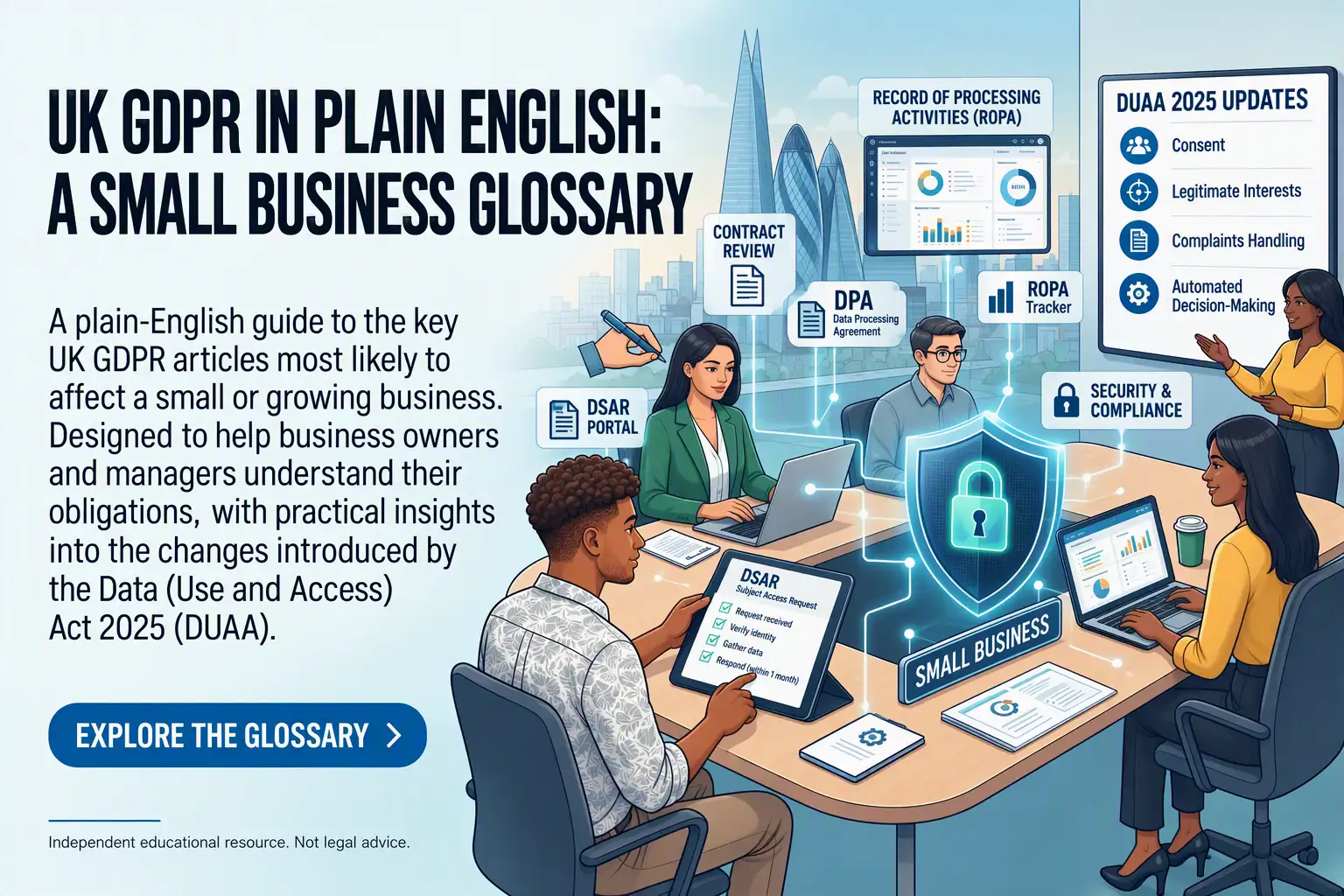
What this glossary covers: UK GDPR glossary for small business
This guide focuses on the UK GDPR articles most relevant to SMEs. It does not cover every article in the legislation and should be read alongside the Data Protection Act 2018, PECR and ICO guidance where relevant.
This translates the UK GDPR articles that actually bite for a small or growing business into plain paragraphs — what each one means in practice, not the legal wording. It covers the roughly 25 articles that come up in day-to-day operations and skips the ones about regulator administration and EU cooperation machinery that a small business may never touch. Where the Data (Use and Access) Act 2025 (DUAA) has changed how an article works in practice, that’s noted inline.
Important disclaimer: This document is intended as a practical guide to help businesses understand the UK GDPR and related legislation. While we may suggest potential courses of action and highlight possible legal, regulatory or commercial consequences, this information is provided for general guidance only and does not constitute legal advice. Every organisation’s circumstances are different, and there is no substitute for advice from a suitably qualified legal professional when making decisions that may have legal or regulatory implications.
Core principles
Article 5 — Principles
What it says: personal data must be processed lawfully, fairly and transparently; collected for specified purposes and not used beyond them; kept to the minimum needed; accurate; kept no longer than necessary; and handled securely. You must be able to show you’re doing all of this.
In practice: this is the “spirit of the law” article — every other article is really just a detailed rule in service of these seven ideas. If you’re ever unsure whether something’s okay, ask: is this fair, is it the minimum I need, and could I explain it to the customer without them being surprised? If yes to all three, you’re usually heading in the right direction, though you should still check the specific rules that apply.
Lawful basis & consent
Article 6 — Lawful basis for processing
What it says: you need one of six legal grounds before you process anyone’s personal data: consent, a contract with them, a legal obligation, vital interests (life-or-death), a public task, or your legitimate interests.
In practice: most small businesses run on two of these — contract (you need their address to deliver the order) and legitimate interests (though marketing activity must also comply with PECR rules, which may require consent in some circumstances). You must pick a basis before you start processing and record which one you used for what. The DUAA 2025 added a specific list of recognised legitimate interests — things like crime prevention, safeguarding and responding to emergencies — where you no longer need to run the full balancing test against the person’s rights; for everything else, legitimate interests still means weighing your reason for doing it against the impact on them.
Article 7 — Conditions for consent
What it says: where consent is your lawful basis, it must be freely given, specific, informed and unambiguous — a clear affirmative act, not silence or a pre-ticked box. It must be as easy to withdraw as it was to give.
In practice: if someone has to tick a box to say yes, don’t make them untick three boxes to say no. Bundling consent into your terms and conditions (“by using this site you agree to…”) generally doesn’t count as valid consent — it has to be a separate, genuine choice. If you can’t offer a real choice (e.g. you’ll provide the service either way), consent is probably the wrong basis — use contract or legitimate interests instead.
Article 9 — Special category data
What it says: health data, racial or ethnic origin, religious or political beliefs, sexual orientation, biometric and genetic data, and trade union membership get extra protection. Processing them is banned by default unless a specific extra condition applies, on top of your normal Article 6 basis.
In practice: this rarely comes up for a typical SME beyond HR — sickness records, a disability a staff member has disclosed, or diversity monitoring data. If you hold any of it, you need a documented reason that fits one of the specific exceptions (e.g. employment law obligations) — “we thought it’d be useful to know” isn’t one of them.
Telling people what you’re doing with their data
Article 12 — Transparent information
What it says: whatever you tell people about how you use their data has to be concise, easy to understand, in plain language, and free of charge.
In practice: if your privacy policy is five pages of legalese nobody reads, it technically exists but doesn’t really satisfy this article in spirit. A short, honestly-worded page beats a long one copied from a template — say what you collect, why, and who you share it with, in sentences a customer would actually read.
Article 13 — Information when you collect data directly
What it says: when you collect someone’s data directly from them (a sign-up form, a sale, a job application), you must tell them — at that point — who you are, why you’re collecting it, your lawful basis, how long you’ll keep it, and their rights.
In practice: this is your privacy notice, linked from every form that collects personal data — contact forms, checkout, newsletter sign-up, job applications. It needs to be available before they submit the form, not buried somewhere they’ll never find it afterwards.
Article 14 — Information when data comes from someone else
What it says: the same disclosures as Article 13, but for data you obtained from a third party rather than the person themselves (e.g. a purchased marketing list, or a referral). You generally have one month to tell them, or do it when you first contact them.
In practice: if you buy or receive a list of contacts from somewhere else, you can’t skip telling those people how you got their details and what you intend to do with them — this is the step most commonly missed when businesses buy in leads.
People’s rights over their data
Article 15 — Right of access (subject access request)
What it says: anyone can ask what personal data you hold on them, why, and who you’ve shared it with — and you must give it to them, usually within one month, free of charge.
In practice: a “subject access request” (SAR) can come from a customer, an ex-employee, anyone — and it doesn’t have to use any special wording; “can I see what data you have on me” counts. Under the DUAA 2025, the one-month clock now pauses (“stops the clock”) while you’re waiting on the requester to clarify what they want, and your search for their data only needs to be reasonable and proportionate — you don’t have to turn the office upside down for a request that’s obviously about one email thread.
Article 16 — Right to rectification
What it says: if someone’s data you hold is wrong or incomplete, they can ask you to fix it, and you should do so without undue delay.
In practice: straightforward — if a customer tells you their address is wrong, correct it. Worth having a quick, obvious way for people to do this (an “update my details” link or a simple email) rather than making them go through a formal process.
Article 17 — Right to erasure (“right to be forgotten”)
What it says: in certain circumstances — the data’s no longer needed, consent is withdrawn, or it was processed unlawfully — someone can ask you to delete their data.
In practice: this isn’t absolute. You can usually refuse (or only partially comply) if you have a legal reason to keep the data — tax records, for example, have statutory retention periods that override an erasure request. The key is being able to explain why you’re keeping something when asked, not simply deleting on demand or refusing on principle.
Article 18 — Right to restriction of processing
What it says: in some situations (e.g. while you’re verifying whether data is accurate, or while a complaint is being resolved) someone can ask you to pause using their data without deleting it.
In practice: think of it as a “hold” rather than a delete — you keep the data but stop actively using it until the issue is sorted. Rare in practice for most small businesses, but comes up if someone disputes something you’ve recorded about them.
Article 20 — Right to data portability
What it says: where processing is based on consent or a contract and done by automated means, someone can ask for their data in a structured, commonly-used, machine-readable format — and ask you to send it directly to another provider where technically feasible.
In practice: mainly relevant if you run a subscription service or app where a customer might want to take their data to a competitor — being able to export someone’s account data as a CSV or JSON file usually covers this.
Article 21 — Right to object
What it says: people can object to processing based on legitimate interests or public task, and you must stop unless you have compelling legitimate grounds. For direct marketing specifically, the right to object is absolute — no exceptions, no balancing test.
In practice: every marketing email needs a working unsubscribe link, and when someone clicks it, that’s final — you stop marketing to them, full stop, no “are you sure” friction and no re-adding them later because you think they’ll be interested again.
Article 22 — Automated decision-making and profiling
What it says: people have the right not to be subject to a decision based solely on automated processing (no human involved) where it has legal or similarly significant effects on them — think automatic credit scoring, automated job-application rejection, or algorithmic pricing.
In practice: the DUAA 2025 actually widened the circumstances in which businesses can use solely-automated decisions, but the safeguards got more specific, not weaker: you must tell people a significant decision was automated, let them make representations, let them contest it, and provide a way for a human to review it on request. If you use any automated scoring, filtering or rejection tool that affects customers or applicants, this is the article to check against.
Running compliance day-to-day
Article 24 — Responsibility of the controller
What it says: you (the “controller” — whoever decides why and how data is processed) must be able to demonstrate compliance, not just claim it.
In practice: this is the “show your working” article. A privacy policy nobody can point to, a decision nobody wrote down, a basis nobody recorded — none of that survives a regulator asking “prove it.” Keep a simple record of the decisions you’ve made and why, even informally.
Article 25 — Data protection by design and by default
What it says: privacy has to be built into a system or process from the start, not bolted on afterwards — and the default settings should always be the most privacy-friendly option.
In practice: when you set up a new form, app or piece of software, ask “do we actually need this field?” before you add it, rather than collecting everything just in case. As a general rule, collect only what you need and use privacy-friendly defaults. For marketing preferences, make sure your approach also complies with PECR.
Article 28 — Processors
What it says: if a third party processes personal data on your behalf (not their own purposes — yours), you need a written contract with them setting out what they can and can’t do with it, and they must only act on your instructions.
In practice: this covers almost every SaaS tool and outsourced service you use — your email marketing platform, payroll provider, IT support company, cloud hosting, CRM. Check that each has a data processing agreement (DPA) in place; most reputable providers publish one and will sign or reference it automatically.
Article 30 — Records of processing activities
What it says: organisations should keep a record of what personal data they process, why, who it’s shared with and how long it’s kept — essentially a map of your data.
In practice: businesses with fewer than 250 employees are exempt unless the processing is regular (not occasional), risky to people’s rights, or involves special category data — which often catches many businesses anyway, since regular customer or HR data processing is unlikely to be considered merely occasional. A simple spreadsheet listing your main data flows (customers, staff, suppliers), lawful basis, sharing and retention periods is often sufficient for many small businesses..
Article 32 — Security of processing
What it says: you must put in place technical and organisational measures appropriate to the risk — things like encryption, access controls, the ability to restore data after an incident, and regular testing.
In practice: this is where Cyber Essentials earns its keep — strong passwords and MFA, restricting who can see what data, keeping software patched, backing up properly, and training staff not to click phishing links. “Appropriate to the risk” means a sole trader’s bar is lower than a company holding thousands of customer records, but everyone needs something in place and documented.
When things go wrong
Article 33 — Notifying the ICO of a breach
What it says: if a personal data breach is likely to risk people’s rights and freedoms, you must tell the ICO within 72 hours of becoming aware of it.
In practice: a breach isn’t just hacking — it includes sending an email to the wrong person, losing an unencrypted laptop, or a misconfigured system exposing customer data. The 72-hour clock is tight, so have a simple plan beforehand: who decides whether to report, who actually files it, and where the ICO’s reporting page is bookmarked.
Article 34 — Telling the people affected
What it says: if a breach is likely to result in a high risk to someone (not just “some” risk — a higher bar than Article 33), you must also tell them directly, without undue delay, in plain language.
In practice: most breaches that need reporting to the ICO don’t clear this higher bar for telling customers directly — but if financial details, passwords or sensitive data are exposed, affected people need to hear it from you, not find out themselves.
Article 35 — Data protection impact assessments (DPIAs)
What it says: before starting any processing likely to result in a high risk to people — large-scale use of sensitive data, systematic monitoring, or new technology like AI tools — you must assess the risks and how you’ll mitigate them, in writing, beforehand.
In practice: Rolling out an AI tool with access to company or customer data may require a DPIA if its use could create a high risk to individuals’ rights and freedoms, particularly where the tool profiles people, influences decisions about them, or has access to large amounts of personal data. It doesn’t need to be a 40-page document — a structured few pages covering what you’re doing, the risks, and how you’re reducing them is enough, and it protects you if anyone ever asks why you went ahead. See a worked DPIA example →
Governance
Article 37 — Designating a DPO
What it says: you must formally appoint a Data Protection Officer if you’re a public authority, or if your core activity involves large-scale systematic monitoring of people, or large-scale processing of special category data.
In practice: most small businesses don’t meet this threshold and don’t legally need a named DPO — but Article 24’s accountability principle still means someone needs to own data protection day to day, even informally. If nobody in the business could answer “who’s responsible for this” today, that’s the gap to close first, DPO or not.
Chapter V (Articles 44–49) — International transfers
What it says: moving personal data outside the UK is restricted unless the destination has an “adequacy” decision (the UK government has assessed its data protection law as good enough) or you put specific safeguards in place, such as Standard Contractual Clauses or the International Data Transfer Agreement (IDTA).
In practice: this catches more businesses than people expect — using a US-based cloud tool, email platform or CRM usually counts as an international transfer. The DUAA 2025 simplified the test for assessing adequacy, but the underlying obligation is unchanged: check where your software providers actually store and process data, not just where their UK sales office is.
New under DUAA 2025 — Handling complaints
What it says: this is a new standalone duty, not tied to a single UK GDPR article — organisations must provide a way for people to complain if they believe their data has been misused, acknowledge the complaint, and tell them the outcome.
In practice: For many SMEs, a simple complaints process published on the privacy page, together with a monitored email address or online form, will be enough to meet the practical requirement. The requirement is to actually respond and close the loop, not just accept the complaint and go quiet. See our own complaints process →
Enforcement
Article 83 — Administrative fines
What it says: two tiers of maximum fine — up to £8.7 million or 2% of global annual turnover (whichever is higher) for the less severe category of breaches, rising to up to £17.5 million or 4% of turnover for the most serious.
In practice: these headline numbers are what make the news, but they’re the ceiling, not the typical outcome — the ICO’s actual enforcement against small businesses is far more likely to start with advice, a warning, or an improvement notice than a maximum fine. The real cost for most SMEs isn’t the fine; it’s the time, reputational damage and client trust lost dealing with a breach that proper basics (Articles 5, 25, 28 and 32 above) would have prevented.
Not sure where your business stands?
A Fractional IT Manager can turn this glossary into an actual compliance plan for your business — what you’re doing right, what needs fixing, and in what order.