

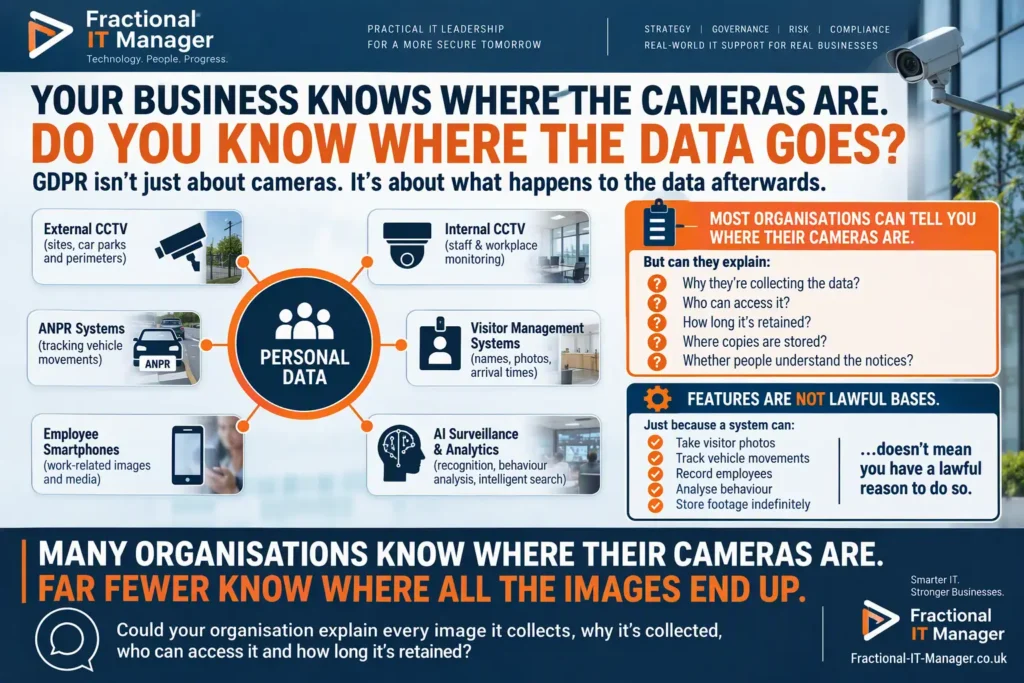
GDPR, CCTV, ANPR and the Modern Camera Estate
Most organisations recognise personal data when it’s stored in a customer database, HR system or CRM platform.
Far fewer recognise that every camera, smartphone, ANPR system and visitor management solution may be collecting personal data continuously throughout the day.
The challenge isn’t simply that images are being captured. It’s that modern systems can now identify, track, analyse and profile individuals in ways that were never envisaged when many organisations first installed them.
The camera hasn’t changed. What has changed is what we can now learn from the footage.
The Hidden Personal Data Estate
Ask yourself a simple question:
Could your organisation produce a complete inventory of every camera gathering personal data today?
For many businesses that list is far longer than expected:
- External CCTV
- Internal CCTV
- ANPR systems
- Doorbell cameras
- Visitor management systems
- Employee smartphones
- Dashcams
- Warehouse cameras
- Access control systems with photo capture
- Teams meeting recordings
- AI-enabled surveillance systems
Every one of these technologies may be processing personal data under UK GDPR.
The question is no longer whether personal data is being processed. The question is whether the organisation can lawfully justify it.
External CCTV: Security or Surveillance?
Most organisations deploy CCTV for legitimate reasons:
- Crime prevention
- Asset protection
- Staff safety
- Health and safety investigations
However, Article 5 requires organisations to ensure that personal data is collected lawfully, fairly and transparently.
A common question I ask is:
If your CCTV system was switched off tomorrow, what business objective would fail?
If the organisation cannot answer that clearly, it may struggle to justify why the footage is being collected in the first place.
Relevant GDPR considerations include:
- Article 5 – Lawfulness, fairness and transparency
- Article 6 – Lawful basis
- Article 13 – Information provided to individuals
- Article 32 – Security of processing
- Article 35 – Data Protection Impact Assessments (DPIAs)
Internal CCTV: A Different Level of Risk
External cameras are usually expected. Internal cameras are more sensitive.
Employees often assume they are at work, not under continuous observation.
Internal monitoring raises questions around:
- Staff privacy
- Workplace surveillance
- Monitoring productivity
- Behaviour analysis
- Disciplinary evidence
The organisation may have a lawful basis, but proportionality becomes critical. Just because a camera can monitor a workspace doesn’t mean it should.
As I’ve said before: features are not lawful bases.
ANPR: It’s Not About Vehicles, It’s About People
One of the biggest misconceptions is that ANPR only records vehicle registrations. In reality, it records the movements of identifiable individuals.
ANPR systems can reveal:
- Arrival times
- Departure times
- Attendance patterns
- Frequency of visits
- Out-of-hours access
- Vehicle movements over long periods
Individually these data points appear harmless. Combined over months or years they create a detailed behavioural profile.
This becomes especially significant when ANPR data is combined with:
- Access control systems
- Visitor records
- CCTV footage
- Employee records
At that point the business isn’t simply monitoring cars. It’s building a timeline of people’s activities.
The GDPR Articles most commonly engaged include:
- Article 4 – Personal Data
- Article 5 – Data minimisation and purpose limitation
- Article 6 – Lawful basis
- Article 22 – Automated decision making
- Article 35 – DPIAs for large-scale monitoring
Visitor Management Systems
Modern visitor systems frequently capture:
- Names
- Company details
- Vehicle registrations
- Signatures
- Photographs
- Arrival and departure times
The critical GDPR question is often overlooked: do we genuinely need all of this information?
Many organisations photograph every visitor simply because the software includes the functionality. Just because the software prompts for a photo doesn’t mean your business has a lawful basis to take one. The fact that a feature exists is not justification for its use.
Article 25, Privacy by Design and Default, requires organisations to minimise data collection wherever possible.
The Smartphone Nobody Talks About
The greatest GDPR risk in many businesses isn’t CCTV. It’s the employee smartphone.
Images are routinely captured of:
- Accidents
- Vehicle damage
- Deliveries
- Customers
- Staff members
- Contractors
- Visitors
Those images often end up:
- In personal photo galleries
- In WhatsApp groups
- In email attachments
- In cloud backups
- On devices outside corporate control
From a GDPR perspective, that should concern every business.
If a phone is lost tomorrow, could the organisation identify exactly what personal data was stored on it? Many cannot.
Relevant Articles include:
- Article 5 – Data minimisation
- Article 6 – Lawful basis
- Article 9 – Special category data
- Article 32 – Security of processing
- Article 33 – Personal data breach notification
“We Have Signs Up” Isn’t Enough
One of the most common misconceptions around CCTV compliance is that displaying a camera icon makes everything lawful. It doesn’t.
Article 13 requires transparency. People need to understand:
- That monitoring is taking place.
- Who is conducting it.
- Why it is being conducted.
- How their information will be used.
- How they can exercise their rights.
What Should a CCTV or ANPR Notice Include?
At a minimum:
- CCTV and/or ANPR in operation
- Organisation name
- Purpose of monitoring
- Contact details
- Reference to the privacy notice
For example:
CCTV and ANPR systems operate on these premises for security, safety and asset protection purposes. Images and vehicle registration details may be recorded and retained. For further information please refer to our Privacy Notice or contact our Data Protection Officer.
How Obvious Should Notices Be?
This is where many businesses fail.
The notice should be visible before an individual enters the monitored area. Not:
- Hidden in a reception area
- Placed behind tinted glass
- Buried in a privacy policy nobody reads
- Mounted next to the camera itself
The principle is simple: people should know they are being recorded before they are recorded.
For ANPR systems this means signage should be positioned so drivers can read and understand the notice before their vehicle registration is captured, not afterwards. For external CCTV it means clear signs around the perimeter. For internal CCTV it means notices at entrances and monitored areas. For visitor management systems it means informing visitors before photographs or personal information are collected.
Transparency in a Multicultural Workforce
As the UK workforce becomes increasingly multicultural, organisations should also consider whether their CCTV and ANPR notices are genuinely understandable to the people being monitored.
UK GDPR does not explicitly require CCTV or ANPR notices to be displayed in multiple languages. However, Article 12 requires privacy information to be provided in a concise, transparent, intelligible and easily accessible form using clear and plain language. The ICO also emphasises that privacy information should be understandable and accessible to those affected.
This raises an interesting governance question: if a driver, employee or visitor cannot understand the notice, have they really been informed before their personal data is collected?
For many organisations, English-only signage may be entirely appropriate. However, businesses operating in sectors such as logistics, manufacturing, distribution, agriculture and transport often have highly diverse workforces and visitors from multiple countries.
In those environments, organisations may wish to consider:
- Multi-language signage for key privacy notices
- QR codes linking to translated privacy information
- Translated employee induction materials
- Visitor privacy notices available in commonly used languages
- The use of universally recognised symbols alongside written notices
The question is not whether GDPR explicitly requires multiple languages. The question is whether your organisation has taken reasonable steps to ensure that individuals understand what information is being collected, why it is being collected and how it will be used.
How Long Should You Actually Keep It?
Retention is where many organisations quietly fall down, because nobody has ever set a figure — footage just accumulates until the storage fills up and old recordings overwrite themselves by default.
There’s no single legal retention period for CCTV or ANPR footage under UK GDPR; the test is purpose limitation under Article 5 — you keep data only as long as it serves the purpose you collected it for. As a working rule of thumb for most SMEs:
- General CCTV (crime prevention, asset protection): 30 days is a widely used default, reflecting how long it typically takes for an incident to come to light.
- ANPR used for access control or site security: often shorter — many organisations purge unmatched reads within days once the vehicle has left site.
- Footage subject to an active incident, investigation, insurance claim or legal hold: retained only for as long as that specific matter requires, then deleted — not indefinitely “just in case.”
- HR or disciplinary use: retained per your disciplinary policy’s own retention schedule, not the CCTV system’s default.
Whatever figure you land on, the test the ICO will apply isn’t whether it’s a “standard” number — it’s whether you can explain why you chose it, that it’s written down, and that the system actually enforces it rather than relying on someone remembering to delete footage manually.
The AI Challenge
Twenty years ago CCTV was reviewed after an incident occurred. Today many systems can:
- Search footage automatically
- Recognise individuals
- Detect behaviours
- Generate alerts
- Correlate movement patterns
- Produce analytical reports
At this point organisations should seriously consider whether a Data Protection Impact Assessment under Article 35 is required.
Because the risk isn’t the camera. The risk is what happens to the information afterwards.
Final Thought
If the ICO walked through your front door tomorrow and asked:
- Why are you collecting these images?
- What lawful basis are you relying upon?
- How long do you keep them?
- Who can access them?
- What notices are individuals given before capture?
Would your organisation be able to answer confidently?
The camera estate in most businesses has expanded dramatically over the last decade. Unfortunately, governance has not always kept pace.
Your CCTV system may have started life as a security tool. Today it may also be an analytics platform, an access control platform and a personal data processing system. Does your governance reflect that reality?
Many organisations know exactly where their cameras are. Far fewer know where all the images end up.